

Yes, you can apply, and some lenders say they will consider you. Several regulated lenders and NBFCs publish pages for freelancers. These pages list bank statements, income tax returns (ITR) or GST records as accepted proof in place of a salary slip (SMFG India Credit (opens in a new tab), Airtel Finance (opens in a new tab), DMI Finance (opens in a new tab)). Each lender sets its own criteria, and approval is always subject to the lender's eligibility checks. This guide explains how a personal loan for freelancers is usually assessed, what to prepare, how to test an EMI against a lean month, and what to read before you sign.
What counts as irregular income, and who this guide is for
Irregular income means your money arrives in uneven amounts or at uneven times. You might drive for a delivery app, take design projects, tutor, or run small client contracts. One month pays well. The next leaves a payday gap.
You are part of a large group. In a 2022 report, NITI Aayog estimated about 77 lakh gig workers in India in 2020-21. It projected 2.35 crore by 2029-30. These are dated estimates, and gig workers are only one part of the wider freelance workforce (PIB (opens in a new tab), Governance Now (opens in a new tab)).
How lenders read irregular income without a salary slip
A salary slip tells a lender two things: how much you earn and how often. Without one, the lender looks for the same answers in other records.
Bank statements and consistency over time
When there is no payslip, lenders typically review bank statements, tax returns and income computations. Some also look at how consistent your earnings are over time (SMFG India Credit (opens in a new tab), Airtel Finance (opens in a new tab), DMI Finance (opens in a new tab)). These are lenders' own descriptions of their practice, not an RBI rule on how variable income must be assessed.
Averaging and look-back windows differ by lender
Lenders do not publish one common method for turning uneven payouts into an eligible income figure. Some look at an average over several months. The window varies. Always check the lender's own requirement.
Minimum income and the score: lender-specific
Minimum income rules also vary by lender and by type of work (SMFG India Credit (opens in a new tab)). As of 7 November 2026, two lender pages quote ₹25,000 a month (DMI Finance (opens in a new tab), Airtel Finance (opens in a new tab)). Treat this as one example of a lender's criteria, not an industry rule.
Who decides: the bureau or the lender
A credit bureau such as TransUnion CIBIL collects your repayment history and calculates your score. The CIBIL score runs from 300 to 900. The bureau does not approve loans. The lender decides whether to sanction one (TransUnion CIBIL (opens in a new tab), Experian India (opens in a new tab)). There is no single score that guarantees approval.
Which records you can show: statements, returns and tax forms
Lenders may ask freelancers for an ITR as income proof. The ITR is not required by every lender, and some lean on bank statements (Airtel Finance (opens in a new tab), SMFG India Credit (opens in a new tab)). If you are searching for a personal loan for self employed without ITR, expect each lender's document list to differ.
| What a lender may ask for | What you can keep ready |
|---|---|
| Bank statements | Statements for the account where your payouts land |
| Income tax return (ITR) | Filed returns and acknowledgements |
| GST records, if registered | GST returns |
| Income computation or contracts | Invoices, client contracts, platform payout summaries |
Some freelancers file ITR-4 (Sugam). For AY 2026-27, this form is for resident individuals whose business or professional income is worked out on a presumptive basis, with total income up to ₹50 lakh. Using it is optional (Income Tax Department (opens in a new tab)). From 1 April 2026, the Income-tax Act, 2025 groups presumptive schemes under section 58, according to tax commentary (TaxGuru (opens in a new tab)). Not every gig worker qualifies. Ask a tax adviser which form fits you.
How to prepare a clearer income record
You cannot control how a lender reads your income. You can make your record easier to read. DMI Finance advises filing your ITR regularly, even when your income is inconsistent (DMI Finance (opens in a new tab)). Lenders also review statements and the consistency of your earnings (SMFG India Credit (opens in a new tab)).
A simple routine, offered as a suggestion:
- Receive client and platform payouts in one bank account where practical.
- Keep your statements, invoices and payout summaries in one folder.
- File your returns on time each year.
- Read the lender's own document list before you apply, and send only what it asks for.
None of these steps guarantees approval. They give the lender a clearer picture of what you earn.
Will the EMI fit your lowest-income month? A worked example
Lenders often use FOIR, the fixed obligations to income ratio. FOIR is your total fixed monthly payments, including the new EMI, divided by your monthly income, shown as a percentage (SMFG India Credit (opens in a new tab), Aditya Birla Capital (opens in a new tab)). Commonly cited comfort zones are roughly 40 to 50%, and some sources call below 40% ideal. Each lender sets its own limit, so these figures are yardsticks, not rules.
An average hides your lean months. A useful check, and this is a suggestion rather than a lender test, is to run the numbers on your lowest month as well.
Say you earn these amounts over six months: ₹18,000, ₹42,000, ₹30,000, ₹24,000, ₹48,000 and ₹36,000. The total is ₹1,98,000, so your average is ₹33,000 a month. Your lowest month is ₹18,000. Say the new EMI is ₹9,000 and you already pay ₹3,000 a month on another loan. Your fixed obligations become ₹12,000.
Illustrative example, invented figures, not real data:
| Month | Income | EMI share (₹9,000) | Fixed obligations share (₹12,000) |
|---|---|---|---|
| 1 | ₹18,000 | 50.0% | 66.7% |
| 2 | ₹42,000 | 21.4% | 28.6% |
| 3 | ₹30,000 | 30.0% | 40.0% |
| 4 | ₹24,000 | 37.5% | 50.0% |
| 5 | ₹48,000 | 18.8% | 25.0% |
| 6 | ₹36,000 | 25.0% | 33.3% |
| Average income (₹33,000) | ₹33,000 | 27.3% | 36.4% |
On your average income, FOIR is 36.4%. This sits below the commonly cited 40 to 50% range. In your lowest month, the same payments take 66.7% of what you earn, well above that range. The EMI alone takes half of the ₹18,000.
The payday gap shows up here. A month like month 1 leaves little for everything else, so a cash buffer matters. Before you borrow, ask how many lean months you can carry from a cash buffer. Whether a lender accepts these numbers is the lender's decision. You can also calculate your EMI (opens in a new tab) for different amounts and tenures (the number of months you take to repay) to find one your lean month can carry.
Check the true cost: KFS, APR and charges
The Key Fact Statement (KFS) is a short, standard summary of your loan's cost and terms. Under the RBI KFS circular of 15 April 2024, lenders must give you a KFS before you sign. The KFS has to follow a standard format and use a language you understand. This applies to retail and MSME term loans sanctioned on or after 1 October 2024, with credit card receivables excluded (RBI (opens in a new tab)).
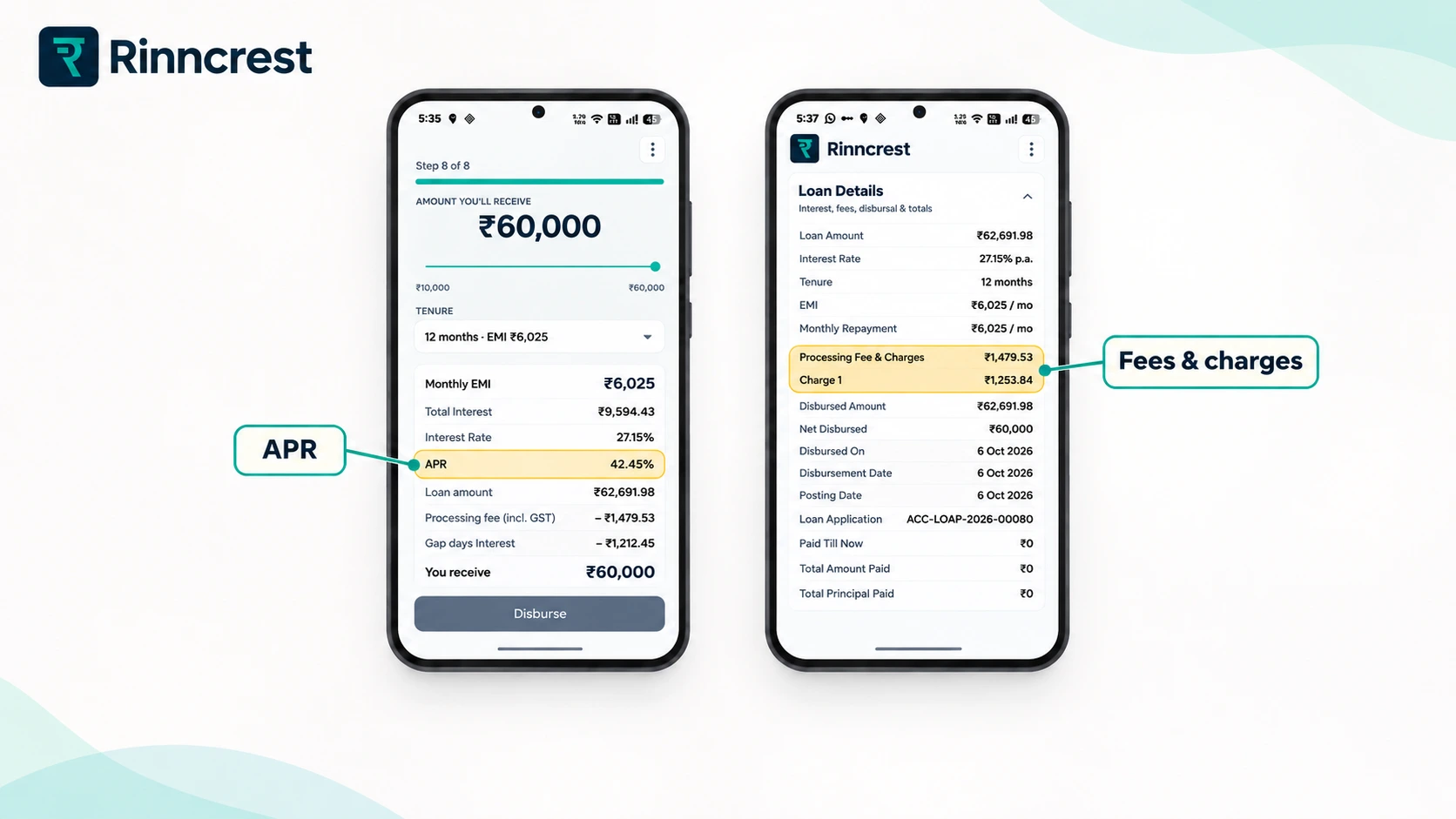
The KFS shows the APR, or annual percentage rate. APR is the yearly cost of credit. It includes interest and all charges the lender levies, so it can be higher than the headline rate. Third-party charges at actual cost are shown separately (RBI (opens in a new tab)). In RBI's own hypothetical illustration, a 15% interest rate becomes an APR of 17.07% p.a. once charges are added (RBI (opens in a new tab), Outlook Money (opens in a new tab)). This is an example, not a real offer.
A lender cannot charge you a fee missing from the KFS during the loan term without your explicit consent (RBI (opens in a new tab)). Before you sign, find these items in your KFS:
- APR, compared across offers
- Every fee and charge listed
- The cooling-off period
- The grievance officer's contact details
When you see rates and charges (opens in a new tab) on any platform, look for the APR beside the interest rate.
Your rights: cooling-off period and where to complain
The RBI (Digital Lending) Directions, 2025, dated 8 May 2025, replaced the 2022 digital lending guidelines (RBI (opens in a new tab), Argus Partners (opens in a new tab)).
Under these Directions, a digital loan comes with a cooling-off period. This is a short window to exit the loan by repaying the principal and the proportionate APR (a proportionate share of the APR-based cost for the days you held the loan), without a penalty. The lender sets the period, which is at least one day, and shows it in your KFS. A reasonable one-time processing fee may apply when you exit (Argus Partners (opens in a new tab), Legal500 (opens in a new tab)).
If something goes wrong, contact the grievance officer named in your KFS first. The lender is responsible for complaints, including those about its service providers. If the lender rejects your complaint or does not resolve it within 30 days, you can escalate it through the RBI Complaint Management System (Argus Partners (opens in a new tab), Legal500 (opens in a new tab)).
Who you are dealing with: the lender, the app and your money
Many loans reach you through an app run by a lending service provider (LSP). An LSP acts as an agent of a regulated lender and carries out some lending tasks on its behalf. The credit decision and compliance responsibility stay with the regulated lender (Legal500 (opens in a new tab), Argus Partners (opens in a new tab)).
Rinncrest is an LSP, not a lender. Loans are offered by its RBI-regulated lending partner, which keeps the credit decision, pricing and the loan contract.
Under the 2025 Directions, the loan amount generally goes straight into your bank account, and you repay straight to the lender. Some exceptions exist. The lender pays the LSP's fees, and the LSP cannot charge them to you. Digital loans are reported to credit information companies, so your repayment record appears in your credit report (Argus Partners (opens in a new tab), Legal500 (opens in a new tab)).
Risks to avoid: many applications, loan stacking and missed payments
When money is tight, applying to several lenders at once can feel sensible. Credit bureaus advise against this. Many applications in a short span can make lenders cautious, because the pattern can look like heavy reliance on credit (Experian India (opens in a new tab), CRIF High Mark (opens in a new tab)).
Each application usually leads to a hard enquiry on your credit report. At most bureaus, hard enquiries stay for about two years, and their effect fades over time. Checking your own score is a soft enquiry and does not lower it (CRIF High Mark (opens in a new tab), Paisabazaar (opens in a new tab)).
Loan stacking means taking several loans close together, often from different apps, so the EMIs pile up. Run the lowest-month test above on all your EMIs together, not on one loan alone.
Because lenders report digital loans to credit information companies, a missed payment can show up in your credit report. Check your loan contract for late-payment charges. If you see a lean month coming, talk to your lender early.
Frequently asked questions
Can a gig worker or freelancer get a personal loan without a salary slip?
Some lenders say they consider bank statements, ITR or GST records instead (DMI Finance (opens in a new tab), SMFG India Credit (opens in a new tab)). Approval depends on each lender's checks. See the section on how lenders read irregular income.
Does my credit score decide whether I get the loan?
No. The bureau calculates the score. The lender makes the decision, weighing your score with other factors (TransUnion CIBIL (opens in a new tab)).
Is the interest rate the full cost of the loan?
No. The APR in your KFS includes interest and the lender's charges, so it can be higher than the rate (RBI (opens in a new tab)).
Does applying to several lenders improve my chances?
Not necessarily. Many applications in a short span can make lenders cautious (Experian India (opens in a new tab)). Apply to one lender at a time.
Can I change my mind after taking a digital loan?
Yes, within the cooling-off period shown in your KFS. You repay the principal and proportionate APR, and a reasonable processing fee may apply (Argus Partners (opens in a new tab)).
This guide is general information, not financial, tax or legal advice.
Conclusion
A personal loan for freelancers is possible with some lenders, even without a salary slip. Your job is to make your income easy to read: one account for payouts, filed returns and your records in one place. Then test the EMI on your lowest month, not your average, and add every EMI you already pay. Read the KFS before you sign, compare APRs, and note your cooling-off period and grievance contact. Apply to one lender at a time.
The Rinn app is launching in November 2026. Loans offered through Rinn come from its RBI-regulated lending partner and are subject to the lender's eligibility checks. Until launch, you can join the waitlist (opens in a new tab), calculate your EMI (opens in a new tab), or read the safety page (opens in a new tab).
If your leanest month of the year repeated, would the EMI still fit?
Sources
- Reserve Bank of India, Key Facts Statement for Loans and Advances, circular of 15 April 2024 (opens in a new tab)
- Outlook Money, RBI mandates lenders to give Key Facts Statement for all retail, MSME loans (opens in a new tab)
- Reserve Bank of India, Guidelines on Digital Lending (page carrying the repeal notice for the 2025 Directions) (opens in a new tab)
- Argus Partners, RBI Digital Lending Directions 2025: An Overview (opens in a new tab)
- Legal500, RBI notifies Reserve Bank of India (Digital Lending) Directions, 2025 (opens in a new tab)
- Press Information Bureau, NITI Aayog report on India's gig and platform economy (opens in a new tab)
- Governance Now, Gig workforce expected to expand to 2.35 crore by 2029-30 (opens in a new tab)
- Income Tax Department, Which ITR form applies to you (opens in a new tab)
- TaxGuru, Analysis of presumptive taxation under section 58 of the Income-tax Act, 2025 (opens in a new tab)
- TransUnion CIBIL, Credit score and loan basics FAQ (opens in a new tab)
- Experian India, Tips to improve your credit profile (opens in a new tab)
- Experian India, FAQs (opens in a new tab)
- CRIF High Mark, Credit enquiries on your credit report (opens in a new tab)
- Paisabazaar, What happens when you apply for multiple personal loans (opens in a new tab)
- SMFG India Credit, Personal loan for gig workers in India (opens in a new tab)
- Airtel Finance, Personal loan for freelancers (opens in a new tab)
- DMI Finance, Personal loans for freelancers in India (opens in a new tab)
- SMFG India Credit, What is FOIR (opens in a new tab)
- Aditya Birla Capital, What is FOIR and how is it calculated for a personal loan (opens in a new tab)