

If you want a personal loan for self employed work, most lenders will ask for three things: your income tax returns (ITRs), your bank statements and proof of your business or practice. For professionals registered under GST, GST returns may be part of the picture too. The exact list varies by lender and by loan amount (Aditya Birla Capital (opens in a new tab), Bank of Baroda (opens in a new tab)).
Your credit score matters as well. A credit bureau calculates the score. The lender alone decides whether to lend (ICICI Bank (opens in a new tab)).
This guide walks through each record, why lenders want it, and how to get ready. You will also see a simple way to check whether an EMI fits your income when some months are strong and others are thin.
How lenders look at income when you do not have a salary slip
A salaried person shows the same credit in the bank every month. Your income may arrive in lumps: a big month after a surgery season, a quiet month while clients delay payment.
Lenders know this. Most look for consistent cash flow over time, not your best month. They read your returns and bank statements to see how steady your income is and what you already owe (Aditya Birla Capital (opens in a new tab), Poonawalla Fincorp (opens in a new tab)).
The records lenders usually ask for
Here are the personal loan documents most lenders ask self-employed applicants for. Treat this as a typical list. Always check your lender's own list.
| Record | What it shows | Who needs it |
|---|---|---|
| KYC and PAN | Who you are | Everyone |
| Income tax returns | Your declared income, year by year | Most applicants. Usually the last two or three years. Some lenders ask for fewer |
| Bank statements | Money coming in and going out, and existing EMIs | Most applicants. Often six months, sometimes up to a year |
| Business or practice proof | Your business or profession exists | Most applicants. Registration certificates, licences or GST registration are common options |
| GST returns | Turnover reported to GST | Only if you are registered under GST |
| Audited financials, profit and loss statement, invoices or client contracts | Extra detail on income | Some lenders, mostly for larger amounts |
Sources: Aditya Birla Capital (opens in a new tab), Bank of Baroda (opens in a new tab), Tata Capital (opens in a new tab), Poonawalla Fincorp (opens in a new tab).
Income tax returns: ITR-4 or ITR-3
Lenders treat your ITR as the main proof of income when you are self-employed (Aditya Birla Capital (opens in a new tab), Bank of Baroda (opens in a new tab)). So the form you file matters to you.
Many professionals, such as doctors, chartered accountants, lawyers and architects, can use presumptive taxation under Section 44ADA. In plain terms, the tax law treats 50% of your gross receipts as your income. You may declare more if you earn more. As of assessment year 2026-27, this applies up to ₹50 lakh of gross receipts, or ₹75 lakh if cash receipts are no more than 5% of the total (Income Tax Department (opens in a new tab), ClearTax (opens in a new tab)).
Professionals using presumptive taxation may be able to file ITR-4 (Sugam). This form is for resident individuals, HUFs and firms (other than LLPs) with total income up to ₹50 lakh. ITR-4 is optional, and exclusions apply (Income Tax Department (opens in a new tab)).
Anyone not eligible for ITR-1, ITR-2 or ITR-4 files ITR-3. This is the general return for income from a business or profession (Income Tax Department (opens in a new tab)). Check which form applies to you, or ask your tax adviser.
Bank statements
Your bank statements show your real cash flow: client payments in, rent and EMIs out. Lenders often ask for six months of statements, sometimes up to a year (Bank of Baroda (opens in a new tab), L&T Finance (opens in a new tab)). Check your lender's list before you download them.
GST records, only if you are registered
Not every professional is registered under GST. Registration is needed above a turnover threshold, or in certain other cases. For services, the threshold is generally ₹20 lakh in a financial year, lower in some states (CGST Act, Section 22 (opens in a new tab), CBIC (opens in a new tab)).
Without GST registration, you will have no GST returns. Lenders accept other business proof (Bank of Baroda (opens in a new tab)).
Registered professionals file GSTR-3B. This return declares your supplies and input tax credit, and you pay tax through it. Since 1 January 2021, taxpayers with turnover up to ₹5 crore can choose to file quarterly under the QRMP scheme while paying monthly (GST portal (opens in a new tab), TaxGuru (opens in a new tab)).
Records to cross-check your own income
Before you apply, compare your numbers with what the tax department sees. You can view your Annual Information Statement (AIS) and annual tax statement (Form 26AS) on the e-filing portal (Income Tax Department (opens in a new tab)).
Form names are changing under the Income-tax Act, 2025. Form 26AS is being replaced by Form 168, so portal labels may look different (Income Tax Department (opens in a new tab), CA Rajput (opens in a new tab)).
This check is for you. Matching figures help you avoid surprises.
What if you have no ITR or limited proof of income
If you have no ITR or little proof of income, the honest answer is that your options may be narrower.
Lenders cannot easily judge how steady your income is without returns. So a lender may offer a smaller amount or ask for extra documents, such as bank statements, invoices or client contracts (Tata Capital (opens in a new tab), Poonawalla Fincorp (opens in a new tab)).
Filing your returns on time is the clearest record of your income. If you have skipped a year, talk to a tax adviser before you plan a loan.
Other things lenders weigh besides documents
Personal loan eligibility for self employed applicants also depends on:
- How long your business or practice has run
- Your credit score
- Your age
- What you already owe
- Your income level
Each lender sets its own thresholds for these (Aditya Birla Capital (opens in a new tab), Federal Bank (opens in a new tab)).
A word on credit scores. Credit bureaus (credit information companies such as CIBIL) calculate your score on a 300 to 900 scale. They do not lend. The lender decides (CIBIL (opens in a new tab), ICICI Bank (opens in a new tab)). Rinncrest does not calculate scores or decide loans either.
Payment history is a major factor in your score. Many loan applications in a short period, or a lot of recent new credit, can make lenders cautious (CIBIL (opens in a new tab), Paytm (opens in a new tab)).
How to prepare before you apply
Use this checklist a few weeks before you apply for a self employed personal loan.
- Gather your ITRs for the last two or three years, with acknowledgements.
- Download six to twelve months of bank statements for the account where your income lands.
- Keep your business proof ready: registration, licence or GST certificate if you have one.
- Cross-check your income against your AIS and annual tax statement on the income tax portal.
- Get your credit report. Each credit bureau must give you one free full credit report, with your score, once every calendar year on request. This rule has applied since 1 January 2017 (RBI (opens in a new tab), TaxGuru (opens in a new tab)). Check for errors.
- List every EMI and card payment you already make each month.
- Apply with one lender at a time instead of several at once.
Check what you can afford: a worked example with uneven income
EMI affordability is the step most people skip. Here is a simple test you can repeat with your own numbers.
An EMI (equated monthly instalment) on a standard reducing-balance loan follows one formula.
- P is the amount you borrow.
- r is the monthly interest rate (the yearly rate divided by 12, then by 100).
- n is the number of months (HDFC Bank (opens in a new tab), ICICI Bank (opens in a new tab)).
Any EMI calculator does this for you.
Lenders use a measure called FOIR (fixed obligation to income ratio). It is the share of your monthly income going to fixed payments such as existing EMIs and card dues, plus the new EMI. Many lenders work in a range of roughly 40% to 60%. This varies by lender and is not a regulation (BankBazaar (opens in a new tab), Paisabazaar (opens in a new tab)).
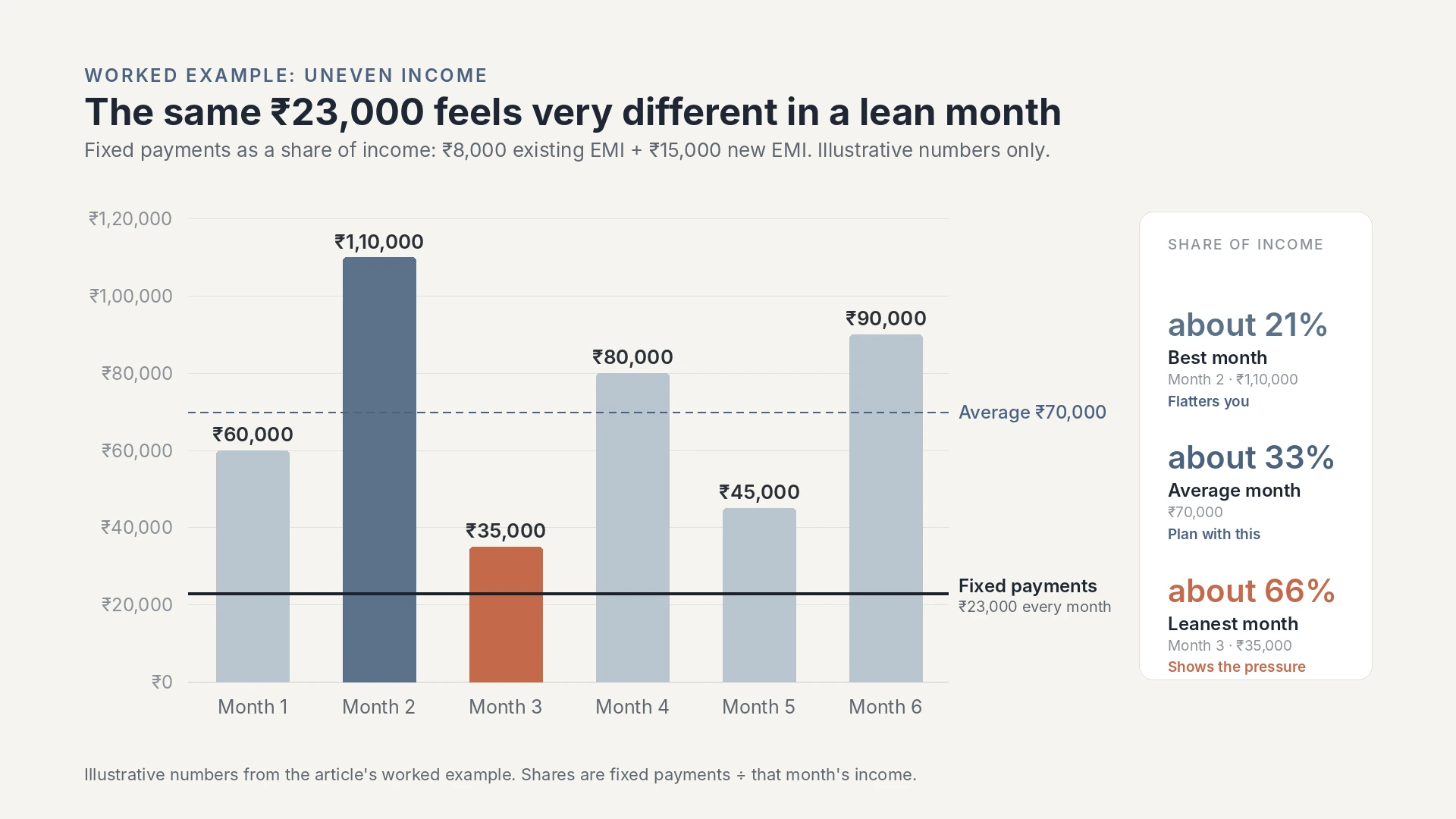
Now the example. Say you are a consultant with this income over six months. These numbers are illustrative only.
| Month | Income |
|---|---|
| Month 1 | ₹60,000 |
| Month 2 | ₹1,10,000 |
| Month 3 | ₹35,000 |
| Month 4 | ₹80,000 |
| Month 5 | ₹45,000 |
| Month 6 | ₹90,000 |
| Total | ₹4,20,000 |
| Average | ₹70,000 |
Say you already pay ₹8,000 a month on another loan. The new loan you are considering has an EMI of ₹15,000. Your fixed payments would be ₹23,000 a month.
- Against your average month (₹70,000), that is about 33% of income.
- Against your best month (₹1,10,000), it looks like about 21%.
- Against your leanest month (₹35,000), it is about 66%.
The average is the honest number to plan with. Your best month flatters you. Your leanest month shows the pressure you may feel. If ₹23,000 would leave you short in a month like Month 3, keep a cash buffer or borrow less. Averaging over six to twelve months is a sensible way to see your true position.
Risks to weigh: loan stacking and missed payments
Loan stacking means taking several loans close together. Each one adds a fixed payment, and your income does not grow to match. A lean month then hits harder. Lenders see this in your FOIR (BankBazaar (opens in a new tab)).
Missed payments carry their own cost. Payment history is a major factor in your credit score, so a missed EMI can weigh on your profile for future borrowing (CIBIL (opens in a new tab), Paytm (opens in a new tab)).
What to ask your lender: KFS, APR, cooling-off and grievance route
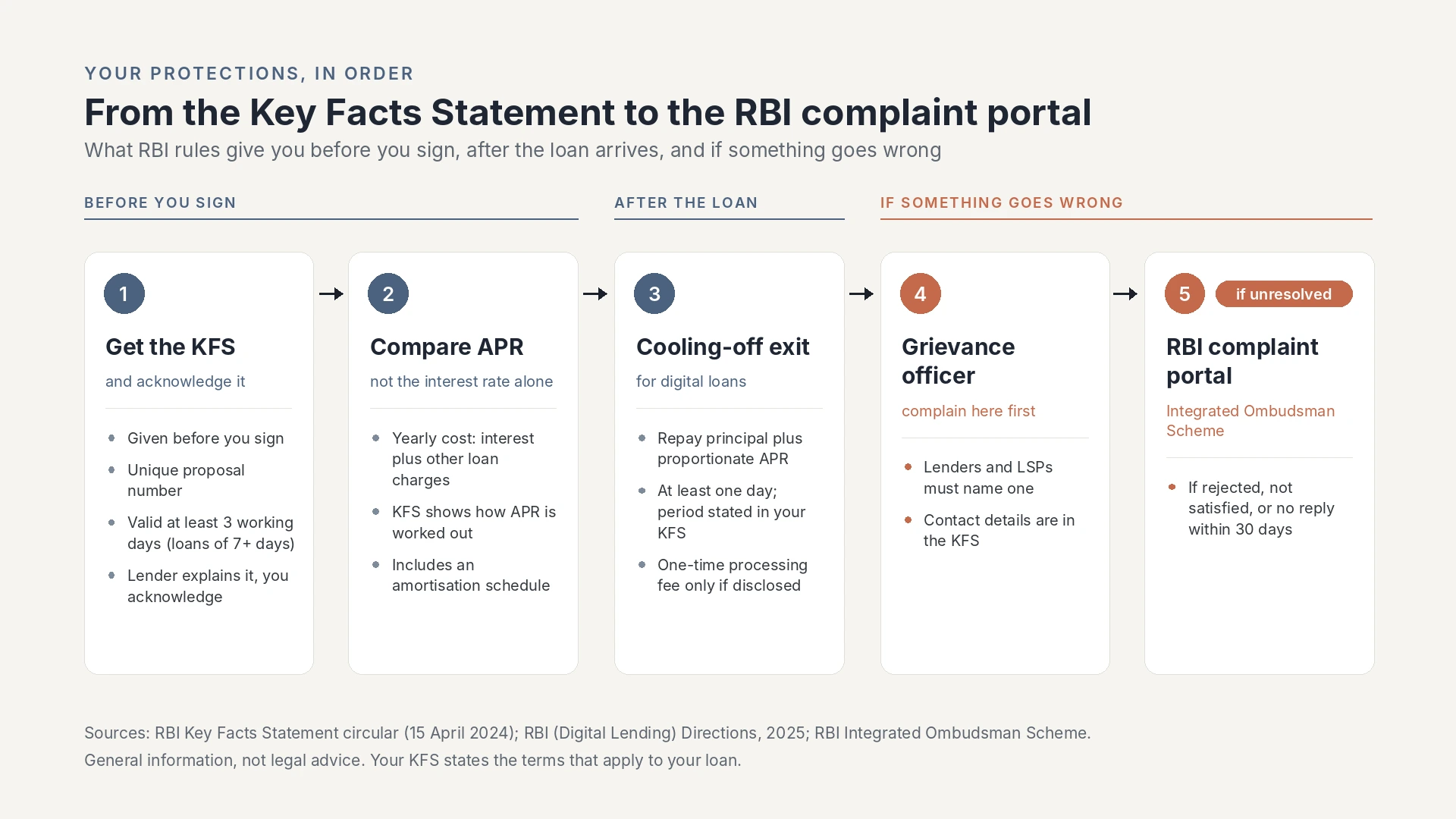
These protections come from RBI rules. Know them before you sign.
Key Fact Statement (KFS)
Under the RBI circular on Key Facts Statement for Loans and Advances, dated 15 April 2024 (as amended), banks and NBFCs must give you a KFS before you sign a retail or MSME term loan contract (credit card dues are excluded). This applies to loans sanctioned on or after 1 October 2024 (RBI (opens in a new tab), Vinod Kothari (opens in a new tab)). The KFS carries a unique proposal number. For loans of seven days or more, it must stay valid for at least three working days. The lender must explain it and take your acknowledgement.
APR (annual percentage rate)
APR is the yearly cost of credit to you. It includes the interest rate and other charges tied to the loan. The KFS shows how the APR is worked out and gives an amortisation schedule, which lists each instalment and how much goes to interest and principal (RBI (opens in a new tab)). Compare loans on APR, not on the interest rate alone.
Cooling-off period
Under the RBI (Digital Lending) Directions, 2025, dated 8 May 2025, you can exit a digital loan during a cooling-off period. You repay the principal and the proportionate APR. The lender's board sets the period, which must be at least one day. Your KFS states the period. A reasonable one-time processing fee may apply if disclosed in the KFS (RBI (opens in a new tab), Mondaq (opens in a new tab)).
Money goes straight to you
A digital loan must be paid directly into your bank account. It cannot pass through a third party, including an LSP, except in narrow cases (RBI (opens in a new tab)).
Credit reporting and consent
Lenders must report digital loans to credit bureaus, including loans arranged through LSPs. Your data can be collected only with your prior, explicit consent (RBI (opens in a new tab)).
Grievance route
Lenders and LSPs must name a grievance officer, and the KFS lists the contact details. Complain there first. If your complaint is rejected, you are not satisfied, or you get no reply within 30 days, you can go to the RBI complaint portal under RBI's Integrated Ombudsman Scheme (RBI (opens in a new tab), RBI Ombudsman FAQs (opens in a new tab)).
FAQs
Can a self-employed person get a personal loan?
Yes, many lenders lend to self-employed people. They assess your returns, bank statements and business proof, and the lender decides.
Do I need GST records for a personal loan?
Only if you are registered under GST. If you are not, lenders accept other business proof.
Which ITR form should a professional file?
ITR-4 if you use presumptive taxation and qualify, otherwise ITR-3. Check which form applies to you.
Can I back out after signing?
For digital loans, yes, during the cooling-off period stated in your KFS, by repaying the principal and proportionate APR.
Will many applications hurt my credit profile?
Many applications in a short period can make lenders cautious. Apply with one lender at a time.
Can I get my credit report for free?
Yes. Each credit bureau must give you one free full report, with your score, once every calendar year on request.
Conclusion
A personal loan for self employed professionals comes down to preparation. Put your ITRs, bank statements and business proof in order. Cross-check your income on the tax portal. Test the EMI against your average month, then against your leanest one. Before you sign, read the KFS and compare APRs, and note your cooling-off period and the grievance contact.
Rinn launches in November 2026. Loans on Rinn will be offered by our RBI-regulated lending partner, subject to its eligibility checks. If you want to know when it opens, join the waitlist (opens in a new tab).
Sources
- Reserve Bank of India (Digital Lending) Directions, 2025 (opens in a new tab)
- RBI: Key Facts Statement (KFS) for Loans & Advances, RBI/2024-25/18, 15 April 2024 (opens in a new tab)
- RBI: Integrated Ombudsman Scheme FAQs (opens in a new tab)
- RBI: Free annual credit report direction (opens in a new tab)
- Income Tax Department: File ITR-4 (Sugam) Online (opens in a new tab)
- Income Tax Department: Individual having Income from Business / Profession (opens in a new tab)
- Income Tax Department: AIS, Annual Information Statement (opens in a new tab)
- Income Tax Department: Form 168 (Earlier Form 26AS) (opens in a new tab)
- CGST Act 2017, Section 22 (opens in a new tab)
- CBIC: GST, An Update (1 May 2019) (opens in a new tab)
- GST portal: QRMP Scheme FAQs (opens in a new tab)
- CIBIL: Understanding your credit information report (opens in a new tab)
- CIBIL: Credit score and loan basics FAQs (opens in a new tab)
- Vinod Kothari: RBI frames KFS norms for all retail and MSME loans (opens in a new tab)
- Mondaq: RBI Digital Lending Directions 2025, an overview (opens in a new tab)
- Aditya Birla Capital: Personal Loan For Self Employed, A Complete Guide (opens in a new tab)
- Tata Capital: Personal Loan for Self-Employed Without ITR (opens in a new tab)
- Bank of Baroda: Personal loan documents required (opens in a new tab)
- Poonawalla Fincorp: Personal loan without ITR (opens in a new tab)
- L&T Finance: How to get a personal loan without ITR (opens in a new tab)
- Federal Bank: Personal loans for self-employed persons (opens in a new tab)
- ICICI Bank: CIBIL score explainer (opens in a new tab)
- ICICI Bank: How to calculate your personal loan EMI using Excel (opens in a new tab)
- HDFC Bank: Personal Loan EMI Calculator (opens in a new tab)
- BankBazaar: Fixed Obligations to Income Ratio (FOIR) (opens in a new tab)
- Paisabazaar: What is FOIR (opens in a new tab)
- Paytm: Does applying for multiple loans hurt your CIBIL score (opens in a new tab)
- ClearTax: Section 44ADA (opens in a new tab)
- TaxGuru: QRMP scheme (opens in a new tab)
- TaxGuru: Free annual credit report to individuals (opens in a new tab)
- CA Rajput: Form 26AS replaced by Form 168 under the Income-tax Act 2025 (opens in a new tab)