

You can apply for a personal loan without salary slip documents at some lenders, as long as you can show your income another way (SMFG India Credit (opens in a new tab), Shriram Finance (opens in a new tab)). The slip is one kind of proof. Bank statements and income tax returns are others. Approval is the lender's decision, and so is the price.
This guide walks you through what to show, what gets checked and how to judge what you can afford.
No salary slip is not the same as no income proof
A salary slip tells a lender two things: you earn money, and you earn it regularly. If you freelance, run a shop, drive for a platform or get paid by clients over UPI, you have no slip. You still have income.
Lenders still want to see your income and your ability to repay (ICICI Bank (opens in a new tab), Ruloans (opens in a new tab)). You may see offers of a personal loan without income proof. A loan without salary slip is a different thing. Your income is checked through other papers, and you may be asked for two or three of them together (Shriram Finance (opens in a new tab)).
What can stand in for a salary slip
For a personal loan for self employed people, freelancers or gig workers, these are the documents you are most likely to be asked for. The exact list depends on the lender.
| Document | What it shows | What to check before you apply |
|---|---|---|
| Bank statements | Money coming in, how often, and from where | Commonly 6 to 12 months, varies by lender |
| Income tax returns (ITR) | Income you have declared to the tax department | Ask how many years the lender wants |
| Business financial statements | Profit and loss, and balance sheet | Some lenders ask for audited accounts |
Bank statements
Bank statements are among the most commonly requested alternatives (Shriram Finance (opens in a new tab), Ruloans (opens in a new tab)). Lenders commonly ask for the last 6 to 12 months. There is no single standard period, so check with the lender you apply to (Union Bank of India (opens in a new tab), Bank of Baroda (opens in a new tab)).
Statements work best when your income lands in one account and shows up month after month. A statement alone may not be enough. Expect a request for at least one more document.
Income tax returns
Income tax returns are another commonly accepted alternative (SMFG India Credit (opens in a new tab), Ruloans (opens in a new tab)). How many years of returns a lender wants differs from one lender to the next. If you are searching for a personal loan without ITR, the answer depends on the lender, and other proof may be asked for in its place.
Business financial statements
Business owners and people running a practice may be asked for a profit and loss statement and a balance sheet (ICICI Bank (opens in a new tab), Shriram Finance (opens in a new tab)). Some lenders ask for these to be audited. Many freelancers do not have audited accounts, so ask early what the lender will accept.
Where Form 16A fits
Form 16 and Form 16A are both TDS certificates. TDS (tax deducted at source) is tax taken out of a payment before it reaches you.
- Form 16 is the annual certificate an employer issues for tax deducted from salary.
- Form 16A is a quarterly certificate a deductor issues for tax deducted from non-salary payments, such as some professional fees (TRACES (opens in a new tab), Kotak Life (opens in a new tab)).
So if you freelance, you will not have a Form 16 from a client. Whether a lender looks at Form 16A is up to the lender. These form names come from the Income-tax Act, 1961, and they may be renumbered under the Income-tax Act, 2025 and its 2026 Rules, so check the name on any certificate you receive.
What a lender may still check
Without a slip, the lender may look more closely at the rest of your profile (SMFG India Credit (opens in a new tab), Shriram Finance (opens in a new tab)). Checks vary by lender, and they may include the following.
Identity and KYC
KYC (know your customer) is the identity and address check lenders run. Keep your documents current and matching across records.
Credit history
A credit bureau keeps a record of your past loans and cards and calculates your credit score. Your lender reads that record and decides. Your score is one factor among several. A higher score helps, but it does not guarantee approval, and each lender sets its own expectations (Ruloans (opens in a new tab), Shriram Finance (opens in a new tab)).
Existing EMIs against your income
An EMI (equated monthly instalment) is the fixed amount you repay each month. Lenders weigh the EMIs and card dues you already pay against your income and the loan you ask for (SMFG India Credit (opens in a new tab), Shriram Finance (opens in a new tab)). High existing obligations are a common reason for a no.
Your consent for data
Under the Reserve Bank of India (Digital Lending) Directions, 2025, issued on 8 May 2025, data collected in digital lending must be need-based and taken with your prior and explicit consent (RBI (opens in a new tab)). You can withdraw consent you have given (Sahamati (opens in a new tab)).
Sharing bank data with consent
Some lenders may offer to read your bank data through the Account Aggregator framework. Account Aggregators are RBI-regulated entities, and they share your financial information only when you consent (Department of Financial Services (opens in a new tab), Sahamati (opens in a new tab)).
Why the loan can cost more
Without a salary slip, your loan can cost more. Lenders build a risk premium into their pricing, and thinner or irregular income records can read as higher risk (RBI (opens in a new tab), Ruloans (opens in a new tab), Shriram Finance (opens in a new tab)).
This is a tendency, not a rule. Some lenders say their rates for self-employed borrowers sit in the same range as for salaried ones (Bajaj Finserv (opens in a new tab)). Your price depends on the lender and on your overall profile.
Two tools help you compare honestly.
- APR (annual percentage rate). APR is the yearly cost of the loan. It includes interest and all charges the lender levies. Charges the lender collects on behalf of third parties are also part of the APR, and the KFS lists them separately (RBI (opens in a new tab)). Compare APRs, not headline interest rates.
- KFS (Key Fact Statement). A KFS is a short summary of the loan's terms, including the APR. Regulated lenders must give you one before you sign, for retail and MSME term loans sanctioned on or after 1 October 2024, under the RBI circular of 15 April 2024 (RBI (opens in a new tab)). The KFS rule does not cover credit card dues.
If your lender is an NBFC (non-banking financial company), it must disclose how it grades risk and why different borrowers may pay different rates, in the application form and sanction letter (RBI (opens in a new tab), RBI (opens in a new tab)). Banks follow separate directions.
Check what you can afford before you apply
Irregular income makes one question matter more than any other. Can you pay the EMI in a slow month?
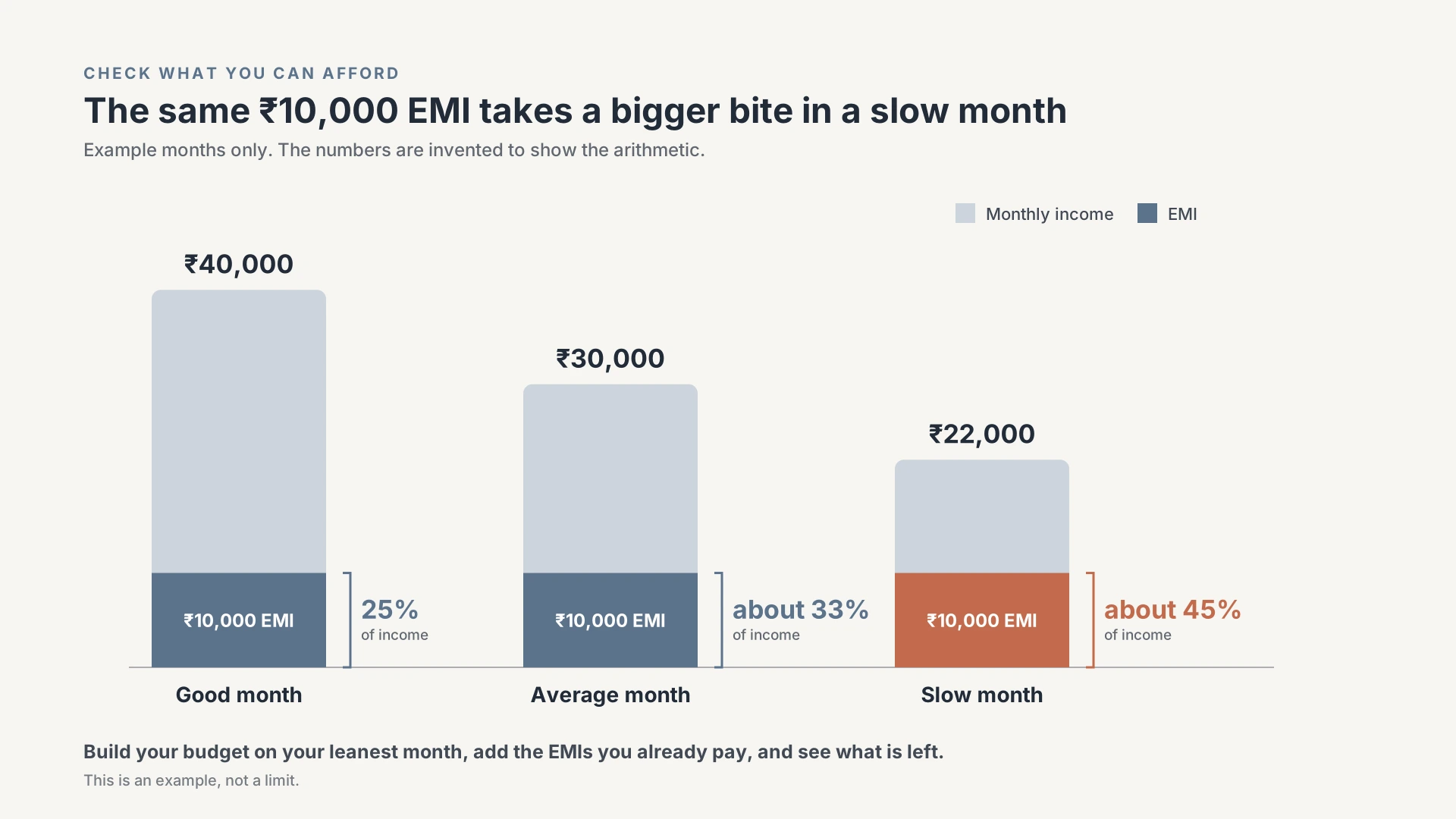
Say you earn ₹40,000 in a good month, ₹30,000 in an average one and ₹22,000 in a slow one. Build your budget on ₹40,000 and a ₹10,000 EMI looks like a quarter of your income. In the ₹22,000 month, the same EMI takes close to half.
| Month (example) | Income | ₹10,000 EMI as a share of income |
|---|---|---|
| Good | ₹40,000 | 25% |
| Average | ₹30,000 | About 33% |
| Slow | ₹22,000 | About 45% |
Use your own leanest month from the last year as the base, add the EMIs you already pay, and see what is left for rent, food and bills.
Two more risks deserve attention.
- Several loans at once. Holding many loans raises your total debt burden. Lenders may become more cautious, and new credit can get harder to obtain (CRIF High Mark (opens in a new tab), Shriram Finance (opens in a new tab)).
- Missed or late EMIs. A missed payment can lower your credit score and stay on your credit report for an extended period (CRIF High Mark (opens in a new tab), Shriram Finance (opens in a new tab)).
Your protections once you borrow
The RBI's Digital Lending Directions, 2025, give you some protections when you borrow through a digital channel (RBI (opens in a new tab)).
Cooling-off period
This is a window after you take the loan when you can exit without a penalty. You repay the principal and the proportionate APR. The lender may keep a reasonable one-time processing fee, which must be shown in the KFS. The window is at least one day, and the lender's Board sets the actual length, so check your KFS (RBI (opens in a new tab), RBI (opens in a new tab)).
Grievance route
Lenders and Lending Service Providers (LSPs) must name a nodal grievance officer on their website or app and in the KFS. Your lender stays responsible for your complaint. If it is not resolved, you can escalate to the RBI's Complaint Management System under the Reserve Bank Integrated Ombudsman Scheme (RBI (opens in a new tab), Mondaq (opens in a new tab)).
Who an LSP works for
An LSP acts as the lender's agent. Under RBI rules, the lender pays the LSP's fees, and the LSP cannot charge them to you. The loan is normally paid into your own bank account, with limited exceptions (RBI (opens in a new tab), Argus Partners (opens in a new tab)).
How to prepare before you apply
- Download 6 to 12 months of bank statements for the account where your income lands.
- Keep your income tax returns ready, and ask the lender how many years it wants.
- If you run a business, keep your profit and loss statement and balance sheet on hand.
- Check your KYC documents are current and consistent.
- List the EMIs and card dues you already pay.
- Work out the EMI against your leanest month, not your best one.
- Read the KFS and compare the APR before you accept.
- Borrow only what you need.
Frequently asked questions
Can I get a personal loan without ITR?
It depends on the lender. Some may accept other proof, such as bank statements or business financials, and others may insist on returns. Approval is the lender's decision either way.
Is Form 16 enough for a freelancer?
A freelancer does not usually receive a Form 16, because Form 16 covers tax deducted from salary. Payments from clients may come with a Form 16A instead. See the Form 16A section above, and ask your lender which documents it wants.
Does a good credit score guarantee approval?
No. A good score helps, but the lender looks at your income, your existing EMIs and its own rules too. There is no single score every lender uses.
Can I change my mind after taking the loan?
For digital loans, yes, within the cooling-off period stated in your KFS. You repay the principal and the proportionate APR, with no penalty. The lender may keep a reasonable one-time processing fee, which must be shown in the KFS.
Conclusion
The salary slip is replaceable. The verification is not. Your job is to show your income clearly, through statements, returns or business accounts, and to borrow an amount you can repay in a slow month. Compare offers by APR, read the KFS before you sign, and keep a note of the cooling-off window and the grievance route.
Rinncrest is a Lending Service Provider. Loans are offered by its RBI-regulated lending partner, subject to the lender's eligibility checks. The Rinn app is launching in November 2026. If you would like to hear when it opens, you can join the waitlist (opens in a new tab).
Sources
- Reserve Bank of India (Digital Lending) Directions, 2025, 8 May 2025 (opens in a new tab)
- RBI circular on Key Facts Statement for loans and advances, 15 April 2024 (opens in a new tab)
- RBI Responsible Business Conduct Directions, 2025 (NBFCs) (opens in a new tab)
- RBI notification on interest rate disclosure by NBFCs (opens in a new tab)
- TRACES: Form 16 and Form 16A FAQ (opens in a new tab)
- Kotak Life: Difference between Form 16 and Form 16A (opens in a new tab)
- Department of Financial Services: Account Aggregator framework (opens in a new tab)
- Sahamati: Account Aggregator FAQ (opens in a new tab)
- ICICI Bank: Personal loan without a salary slip (opens in a new tab)
- SMFG India Credit: Personal loan without salary slip (opens in a new tab)
- Bank of Baroda: How to get a personal loan without salary slip in India (opens in a new tab)
- Union Bank of India: Personal loan documents required (opens in a new tab)
- Shriram Finance: Personal loan without salary slips (opens in a new tab)
- Ruloans: Personal loan without salary slip (opens in a new tab)
- Bajaj Finserv: Personal loan for self-employed (opens in a new tab)
- CRIF High Mark: How EMIs affect your credit score (opens in a new tab)
- Shriram Finance: How missing a personal loan EMI affects your credit score (opens in a new tab)
- Mondaq: RBI Digital Lending Directions, 2025 (opens in a new tab)
- Argus Partners: RBI Digital Lending Directions, 2025, an overview (opens in a new tab)